68° and Clear

Gov. Murphy Issues Statewide Drought Warning


The Murphy Administration today issued a statewide water supply Drought Warning, urging residents and businesses to reduce water use as a result of persistent below-average precipitation and deteriorating water supply conditions across New Jersey.
“The Department of Environmental Protection is closely monitoring drought indicators and water supplies to ensure we have enough water across the state,” said Governor Phil Murphy. “While there are currently no mandatory restrictions in place, it is up to each of us to take precautions now and do our part by conserving water use in and around our homes and businesses.”
“The precipitation and water supply uncertainty we’ve experienced over the past year is a symptom of the impacts of climate change here in New Jersey,” said Environmental Protection Commissioner Shawn M. LaTourette. “We ask residents, businesses, and partners in local government to join us in spreading the urgency of the need to conserve water.”
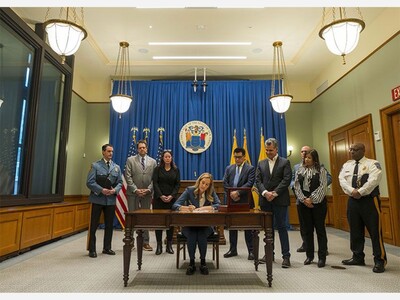
Commissioner LaTourette today signed an Administrative Order authorizing the Drought Warning designation, which is the next stage of drought status after a Drought Watch and a step below a Drought Emergency, which could call for mandatory water-use restrictions. The state had been under a Drought Watch since Oct. 1 of this year.
The last statewide Drought Warning was issued in November 2024. The warning was lifted in June of this year, following record rainfall in May, although the Coastal South region of the state remained in a watch. Overall, though, the state has experienced below-average precipitation for more than a year, leading to the issuance of a Drought Watch in October and today’s issuance of a Drought Warning.

“Over the past 15 months, we’ve seen a significant deficit in precipitation, with only two months exceeding average levels,” said State Climatologist Dave Robinson. “While May 2025 brought much-needed relief as a ‘drought buster,’ it wasn’t sufficient to completely alleviate the ongoing drought conditions.”
Drought Warning Explained
In consideration and preparation for Drought Warning status, DEP has been consulting with water suppliers to assess conditions, ensure that they are fully aware of the situation, and that they are able to work cooperatively with the DEP. The Administrative Order designating Drought Warning status comes a day after the DEP held a virtual public hearing to update water suppliers and the public on water supply conditions, receive their input, and assess all available water supply management options.
The goal of a Drought Warning is to preserve and balance available water supplies to avert more serious water shortages in the future. The Administrative Order establishes a formal process for the DEP to work with water suppliers in affected regions to ensure no single water supplier or region faces a significant shortfall if dry weather and high customer demand continue.
A Drought Warning enables the DEP to more closely manage water systems by directing water transfers among systems, controlling releases from reservoirs, and modifying the permitted rate of flow in streams and rivers downstream of reservoirs to balance ecological protection and needs of water suppliers.
Winter Water Conservation Tips (Also see graphic below)
The public is strongly encouraged to follow these tips to reduce water use:
- Only run the dishwasher and washing machine when they are full.
- Winterize, and shut off irrigation systems as soon as possible.
- Insulate exposed outdoor pipes and hose connections.
- Check pipes for leaks after any thaws, as changing temperatures can cause pipes to break.
- Learn the locations of your home’s water valves to be able to shut off water during emergencies like a burst pipe.
- Use a commercial car wash that recycles water, as washing your car at home typically results in more water use.
- Compost vegetable food waste instead of using the garbage disposal.
- Keep your outdoor jacuzzi or spa covered to prevent evaporation.
- To save water at home, fix leaky faucets and pipes. Consider replacing your toilet with a low-flow version; this can save around 11,000 gallons per year.
- Upgrade your showerhead to low-flow versions, which can save some 7,700 gallons per year.
- Upgrade your faucets or install faucet aerators; this can save some 16,000 gallons per year.
- Use native plants when planning your spring and summer gardens.
- When buying grass seed, choose drought-tolerant grasses, such as fine-leaf fescues.
Types of Droughts and Drought Indicators
There are different types of droughts. Meteorological drought refers to periods of low precipitation and high heat. A hydrological or water supply drought refers to reductions in water supplies, such as reservoirs, streams, and groundwater. New Jersey’s Warning status is for a water supply drought.
DEP is responsible for monitoring and managing water supplies in collaboration with public and private water providers. A water supply drought determination is based upon a lack of precipitation, rapidly declining storage in the combined capacity of major surface water supply reservoirs, and/or severely depleted groundwater levels and stream flows.
The DEP uses specific indicators to gauge the impacts that significantly reduced precipitation has had on water supplies. These include reservoir levels, stream flows, and levels in shallow groundwater sources, known as unconfined aquifers, which are important in the longer-term replenishment of streams and reservoirs.
New Jersey’s persistent drought conditions have resulted in observable stress across all specific indicators that DEP monitors in its assessment of water supply conditions. Current precipitation totals, stream flows and shallow groundwater levels in nearly all regions of the state are classified as being severely or extremely dry.
Reservoir systems are at low levels statewide. In the critical Northeast region, they are below those observed at any point during the Drought Warning period of November 2024 through June 2025.
Drought Region Structure
The DEP organizes New Jersey into six regions in its drought monitoring program, sorting geographic parts of the state based on common water supply sources and watershed boundaries.
Historically, these regions may experience varying severity of drought, and the DEP may tailor its approach to suit each regions’ needs, but in this case, conditions remain markedly dry across the state. These regions are defined using municipal boundaries and details on what municipality is in each region are described here.
Major reservoir systems are below their normal water levels for this time of year and may need transfers of water through interconnected infrastructure to balance storage. When transfers become necessary, DEP works with water systems to ensure that water quality is maintained.
Water Supply Conditions by Region
- Northeast: Primarily served by 12 reservoirs operated by four water suppliers in the most densely populated region of the state, reservoir levels in this region have dropped to 48 percent capacity, compared to a normal level of about 72 percent for this time of year. Specifically:
-
- The North Jersey District Water Supply Commission’s two reservoirs have dropped to about 45 percent capacity, compared to a normal of about 68 percent for this time of year. The Commission serves portions of Bergen, Essex, Hudson and Passaic counties.
- The Veolia-NJ system consists of three reservoirs serving Bergen County that have dropped to about 50 percent total capacity, compared to a normal capacity of 63 percent for this time of year.
- The remaining reservoirs are operated by Newark and Jersey City and are slightly above 50 percent of capacity and are well below levels that were observed this time last year during the previous Drought Warning.
- Central: Predominantly served by New Jersey Water Supply Authority, reservoirs in this region (which includes Middlesex, and parts of Mercer, Somerset, Union, Hunterdon, Warren and Morris counties) are at 79 percent capacity, compared to their normal storage level of 89 percent for this time of year.
- Coastal North: Encompassing much of Monmouth County and the northern portion of Ocean County, this region is predominantly served by the combined storage in reservoirs operated by New Jersey American Water and the New Jersey Water Supply Authority. Reservoirs are at 79 percent capacity, compared to their normal level of 86 percent for this time of year.
The remaining portions of the state are not served predominantly by reservoir-backed surface water supplies but instead have a mix of river-based surface water, or groundwater wells.
- Northwest: Encompassing primarily Sussex and Warren counties, current drought indicators for groundwater levels and precipitation are designated as severely dry and stream flows as extremely dry.
- Southwest: Encompassing Burlington, Camden, Gloucester and Salem counties, this region relies primarily on groundwater but is supplemented by surface water. Drought indicators for groundwater levels in this part of the state are designated as extremely dry while precipitation and stream flows are severely dry.
- Coastal South: Made up of Atlantic, Cape May and Cumberland counties, drought indicators for rainfall in this part of the state are designated as moderately dry, while groundwater levels and stream flows are extremely dry.
Resources
For more state water supply status information and to view the Administrative Order, visit njdrought.org
For more detailed information on water conservation technologies and interesting facts, visit dep.nj.gov/conserve-water/
For more information on water-efficient appliances, visit dep.nj.gov/appliancestandards