45° and Clear
Image
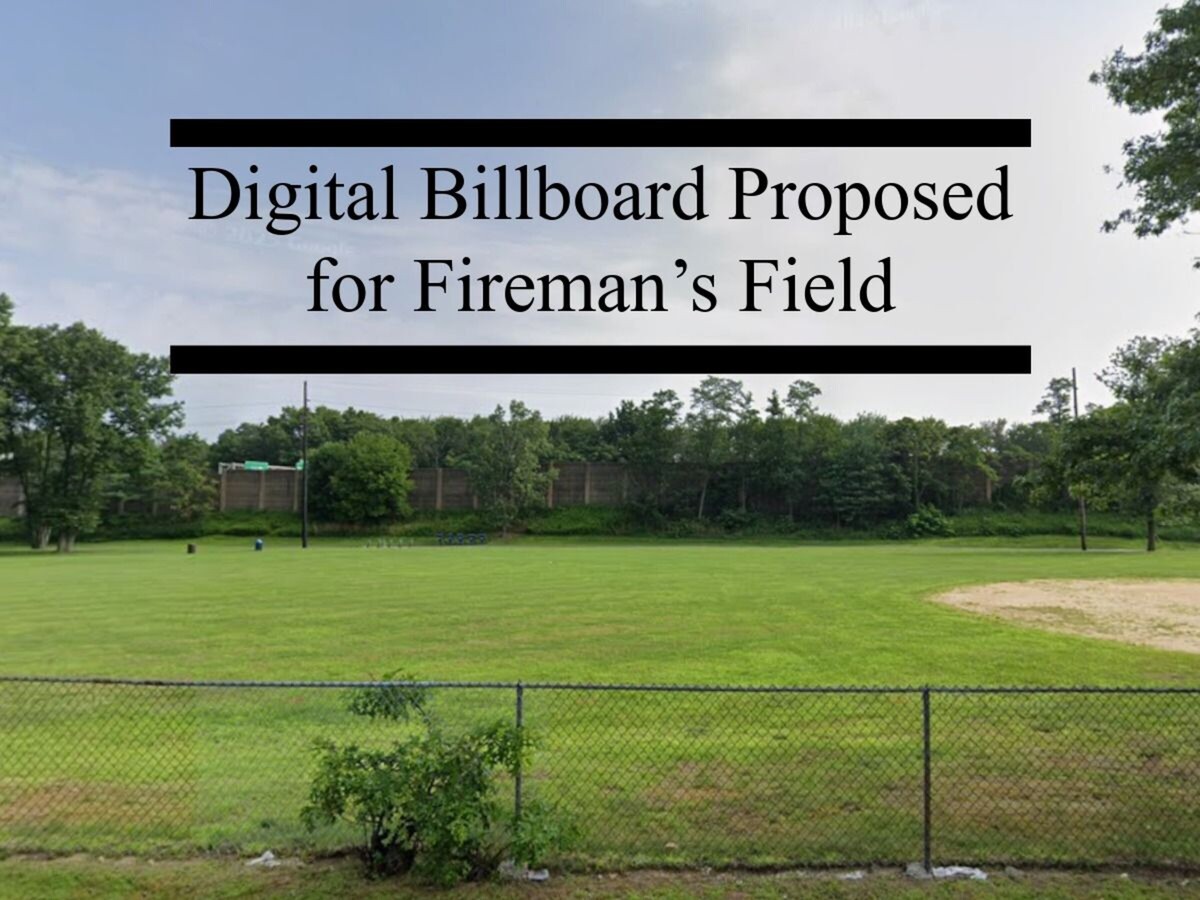
A months-long zoning case over a two-faced sign on Indian Road has become a flashpoint in Denville, as residents question whether a towering digital billboard belongs near homes, ballfields, and the Indian Lake area.



DENVILLE — A proposal to install a roughly 90-foot-tall digital billboard at Fireman’s Field on Indian Road has evolved into one of Denville’s most closely watched local land-use debates, with repeated public hearings before the township’s Board of Adjustment and sustained community opposition focused on nighttime brightness, visual character, and whether the location is appropriate for a large commercial advertising structure.
The application, filed by Outfront Media, seeks approval for a double-faced sign at 2 Indian Road (Block 41006, Lot 1). Under the plan described in Board of Adjustment minutes, the face oriented toward Route 80 would be a digital, off-premises advertising display, while the opposite face would be a static sign intended for the fire department. The proposed height is 90 feet above grade, and the applicant has told the board it already obtained a state outdoor advertising permit from the New Jersey Department of Transportation, though local zoning approval is still required.
Denville’s Board of Adjustment has held multiple hearings on the billboard, including meetings on March 19, May 28, July 23, and Oct. 8, 2025, with the matter carried across sessions as professionals testified and residents raised questions.
As of the Oct. 8 hearing, the applicant’s attorney summarized prior testimony and said the previous session included a traffic engineer’s testimony and a proposal for reduced lighting at the site. The board also continued reviewing updated visual simulations and other exhibits intended to show what the structure would look like from surrounding streets and neighborhoods.
Town officials note that supporting documents for land-use applications are generally available for in-person review at the municipal building during business hours, a policy that can affect how residents access detailed plans and technical reports as the hearings continue.
According to board minutes, Outfront Media’s application requests “use” and “bulk” relief because billboards are not permitted in the site’s zoning district and because the structure’s size and electronic display features exceed what the local code otherwise allows.
At the March 19 hearing, the applicant’s attorney laid out the approvals sought, including a D1 use variance for the digital face, a D6 height variance for the 90-foot structure, and additional variances connected to setbacks and the electronic nature of the sign.
In the Oct. 8 meeting, the project planner described the property as roughly 7 acres in a B3 zone, developed with ballfields and a storage building, with more than 1,000 linear feet of frontage along the Route 80 corridor, and acknowledged that residential areas exist in a wider surrounding ring even as the immediate corridor is heavily transportation-oriented.
Residents speaking during hearings have raised a consistent set of concerns: whether a large digital sign would introduce intrusive light at night, whether it would change the look and feel of the area near homes and the Indian Lake neighborhood, and whether the scale of the structure fits the site.
 A rendering found at Change.org opposing the new billboard
During the Oct. 8 hearing, members of the public pressed the applicant’s engineer and planner on the methodology used to portray the billboard’s visibility, asking about simulation techniques, seasonal differences in tree cover, and why it is difficult to “test” lighting impacts in the same way the applicant conducted a daytime crane test to demonstrate height and sightlines.
Those questions sit alongside a broader dispute over aesthetics and suitability. The applicant’s planning witness told the board that “visibility alone” should not be a basis to deny the application and that aesthetic judgments can be subjective, while residents have argued that the structure’s prominence is precisely the point and would be experienced well beyond the highway corridor.
Digital billboards typically rely on brightness controls and automatic dimming to meet regulatory standards. In New Jersey, state rules governing electronic message sign brightness set maximum luminance levels of 5,000 nits during daylight and 250 nits at other times, and require a light-sensing device that adjusts brightness as ambient light changes.
In Denville’s hearings, lighting has been a recurring focus, including discussions of how far light could travel from the proposed sign and what mitigation tools (such as directional controls or other design features) would be used to limit spillover into nearby neighborhoods. At the Oct. 8 hearing, the board discussed a revised light-distance figure as part of an updated exhibit, and the applicant said reduced lighting had been proposed since the prior session.
Outfront Media’s representatives have argued that the site’s context supports the request. In October, testimony included an exhibit identifying “taller” structures around town, including the hospital, a hotel, and cell towers, presented as a way to frame the sign’s proposed height in the broader built environment.
The planner also emphasized that the sign would be oriented primarily toward Route 80 and that the location already meets NJDOT outdoor advertising criteria, describing the state permitting process as incorporating safety considerations.
At earlier hearings, the applicant introduced environmental testimony aimed at rebutting claims that the sign would disrupt wildlife. At the July 23 meeting, a wildlife biologist and wetlands scientist retained by the applicant described the site as a “developed habitat” already influenced by surrounding lighting and activity, and stated she did not observe significant night wildlife activity during her survey.
Outfront Media is one of the country’s major out-of-home advertising companies, operating billboard and transit advertising networks and offering digital platforms that allow messages to rotate and update quickly.
Beyond the technical arguments, the case has become a referendum on how Denville applies its zoning framework to a proposal that supporters describe as commercially and operationally useful, and opponents describe as out of scale for a community recreation site and nearby residential areas.
The Oct. 8 minutes reflect that the applicant is seeking relief not just for height, but because billboards are not permitted in any zone in the township, placing the burden on the applicant to show that the project meets the legal “positive” and “negative” criteria that govern use variances under New Jersey land-use practice.
The board’s continued hearings will likely determine:
Whether the applicant’s lighting and sightline mitigation proposals satisfy the board’s concerns.
Whether the site is deemed “particularly suitable” for a use not otherwise allowed under township zoning.
Whether the board concludes that any impacts on nearby homes and neighborhood character can be adequately limited through conditions, or whether the use should be denied as incompatible.
For residents tracking the case, the township’s posted agendas and minutes provide the clearest public roadmap of when the application returns and what testimony has been submitted so far.
Bring Meaning Back to the News: Go to TheMinuteman.org to get simple explanations of the trending topics in the news.



Sunny, with a high of 58 and low of 30 degrees. Sunny in the morning, clear during the afternoon and evening,