45° and Clear



Image

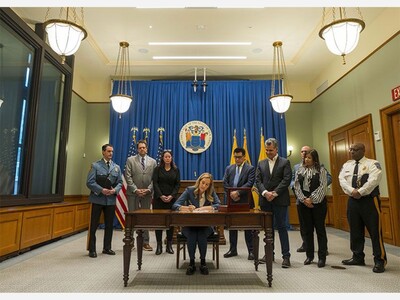
Mikie Sherrill opened her administration by signing six executive orders, including declaring a state of emergency tied to electricity costs, pushing permitting reform, and more.
Sworn in Jan. 20 in Newark, Mikie Sherrill opened her administration by declaring emergencies tied to electricity costs, ordering a faster energy build-out, tightening ethics rules, restructuring executive operations, pushing permitting reform, and launching a cross-agency effort to address kids’ online mental health.
NEW JERSEY — Mikie Sherrill began her first day as New Jersey’s governor on Jan. 20 by signing six executive orders that, taken together, set an early thesis for the administration: treat rising electricity bills and energy constraints as urgent, modernize how state government measures performance and delivers services, and elevate online safety and youth mental health as a statewide priority.
“In the Navy, I learned that you have to lead, follow, or get out of the way – and I promised the people of New Jersey that I would be on a mission to deliver starting Day One. That’s why I’m beginning my term as governor by taking immediate action to deliver on some of the key issues impacting New Jerseyans. My first six executive orders include freezing utility rate hikes, ensuring that officers and staff in my administration are meeting the highest standards of transparency and accountability, bringing agencies together to protect our kids online, and cutting through the roadblocks and red tape that are making it too hard to do business here. Let’s get to work,” said Governor Mikie Sherrill.
Sherrill’s inauguration broke with a long-running first-term tradition by taking place in Newark at the New Jersey Performing Arts Center, rather than in Trenton, underscoring a message of change in both symbolism and policy emphasis.
What she signed on Day One, and what it does, is detailed below.
Sherrill’s first order declares an emergency statewide tied to electricity affordability and directs the New Jersey Board of Public Utilities (BPU) to take near-term steps aimed at cushioning rate increases expected in 2026 while teeing up longer-term reforms.
Key directives include:
Residential Universal Bill Credits: BPU is directed to provide Residential Universal Bill Credits (RUBCs) to offset electricity supply cost increases scheduled to take effect in 2026, with an instruction that the first credits be issued no later than July 1, 2026.
RGGI proceeds discussion: BPU, the Department of Environmental Protection (DEP), and the Economic Development Authority must confer within 30 days about using Regional Greenhouse Gas Initiative (RGGI) proceeds for ratepayer relief and issue a public statement of conclusions, including how relief may be handled in the 2026–2028 RGGI Strategic Funding Plan.
Societal Benefits Charge scrutiny: BPU is directed to review components and rationales for Societal Benefits Charges on electric bills, including the budget for the Clean Energy Program that those charges partially support.
Clean Energy Program budget “true-up”: By May 1, 2026, BPU must issue a “true-up” budget based in part on actual FY2025 expenses, and it is directed to prioritize direct ratepayer relief and identify opportunities to bolster energy-efficiency support for income-qualifying households.
Possible pause in rate cases: The order directs BPU, to the extent permitted by law, to consider pausing or modifying schedules in proceedings where electric distribution utilities seek rate increases or cost recoveries.
Utility business model study: Within 180 days, BPU must issue a study on modernization of the electric distribution utility business model, including options such as performance-based ratemaking and changes that could reduce the link between utility revenue and capital spending.
The order’s underlying assumption is that immediate relief can be paired with structural review, but most of the practical impact depends on how BPU executes the directives, how credits are funded, and what reforms prove legally and politically feasible.
The second order goes further, formally declaring a State of Emergency under New Jersey’s Disaster Control Act and directing multiple agencies to accelerate the development of new electricity supply and related infrastructure. The administration frames this as a response to capacity constraints, permitting bottlenecks, and interconnection delays that can slow projects and push costs upward.
Major components include:
Accelerated solar procurement: Within 45 days, BPU must initiate a solicitation under the Competitive Solar Incentive program, with project awards due within 270 days after the solicitation begins.
Community solar expansion: Within 45 days, BPU is directed to open registration for 3,000 megawatts of capacity under the Community Solar Energy Program and to expedite registration.
Battery storage acceleration: The order directs BPU to move forward on the Garden State Energy Storage Program, including a Tranche 2 solicitation and a Phase 2 launch timeline.
Virtual power plant planning: Within 180 days, BPU must commence development of a “virtual power plant” program to aggregate behind-the-meter resources in an effort to reduce peak demand.
Permitting and potential waivers: Within 45 days, state entities involved in permitting or siting energy generation and grid stabilization projects must send the governor memoranda identifying rules, regulations, and statutes where waivers could speed deployment without unduly compromising health, safety, or environmental protection.
Interconnection pressure on utilities: BPU is directed to require electric distribution utilities to submit filings addressing compliance with interconnection rules and identifying steps to speed the connection of new projects to the grid.
Data center “ghost load” monitoring: BPU must take steps to formulate policies or information requests to monitor duplicative interconnection requests from large electricity users, aiming to reduce “ghost load” that can inflate demand projections.
Nuclear Power Task Force: The order creates an interagency Nuclear Power Task Force to develop a strategy for new nuclear generation in New Jersey, including coordination with the federal government and other states.
For residents and businesses, EO2 is best understood as a timeline-heavy instruction set that pushes agencies to move faster. The measurable outcomes, however, will hinge on follow-through: solicitations, awards, interconnection enforcement, and whether permitting reforms can be implemented within existing statutory constraints.
“I promised the people of New Jersey bold action to lower utility costs and, today, I’m delivering. Trenton will no longer accept the status quo and kick the can down the road while New Jersey families pay higher bills – not on my watch. These executive orders will deliver relief to consumers and stop rate hikes, so New Jerseyans aren’t facing ever increasing electric bills. This will also create the conditions to massively expand New Jersey’s power generation, because more power in-state will help lower costs. I heard the people of New Jersey loud and clear – these rate hikes are unacceptable – and as your governor, I will not stop fighting to lower costs and make New Jersey a more affordable place to live, work, and raise a family,” said Governor Mikie Sherrill.
EO3 establishes ethical standards for public employees and officers serving in the Sherrill administration, continuing and detailing disclosure and conflict-of-interest expectations and assigning enforcement responsibilities to the State Ethics Commission.
The order includes:
Personal financial disclosure requirements for defined categories of officials and employees, specifying what must be reported and how statements are filed and maintained for public inspection under applicable public-records rules.
Blind trust provisions describing conditions for insulating officials from conflicts involving investments, including Ethics Commission approval and restrictions on disclosures to the grantor.
Limits and disclosure requirements for interests in closely held entities doing business with government bodies, with review procedures and timelines.
While ethics executive orders are a familiar feature of gubernatorial transitions, EO3’s practical effect is in how aggressively the standards are interpreted, enforced, and integrated into day-to-day staffing and procurement decisions.
EO4 establishes an Office of the Chief Operating Officer (COO) within the Governor’s Office and outlines its role as a central hub for operational performance, customer service improvements, and cross-departmental execution of strategic priorities.
Among the order’s core directives:
The COO serves as the governor’s principal adviser on strategic initiatives, operational performance, and organizational effectiveness.
The office is tasked with creating cross-department working groups focused on modernizing government services, simplifying processes and regulations, and streamlining permitting across agencies.
Agencies are directed to designate senior liaisons to coordinate with the COO across areas including regulation, procurement, budget, and digital services.
EO4 sets up internal machinery that the administration can use to track progress and pressure agencies to meet timelines, including on permitting and affordability priorities that are also addressed in other orders.
EO5 follows through on the administration’s stated goal of reducing delays and costs in permitting and expanding transparency around spending and service delivery.
The order creates:
A Cross-Agency Permitting Team housed under the Strategic Initiatives & Economic Opportunity Office within the COO structure, with instructions to collect data, identify bottlenecks, and coordinate solutions.
A requirement that agencies catalog permit types within 90 days, including steps, expected timelines, fees, and hand-offs, plus recommendations on what constitutes a complete application and how processing timelines could be improved.
A framework for presumptive permitting timeframes, described as “shot clocks,” while explicitly stating the timelines do not create new legally enforceable rights or standards.
A Permitting Dashboard, described as an interactive public portal showing the status and progress of state permit applications, intended to improve transparency and accountability.
A Regulatory Simplification Team to propose and implement reforms to state regulatory structures aimed at reducing delays and costs, including evaluation of technology and process changes.
A New Jersey Report Card, an interactive portal housed within the Governor’s Office designed to display select program information, an interactive budget analysis tool, and evaluations of select state-funded programs.
For communities navigating redevelopment, infrastructure work, or major public-private projects, EO5 is potentially consequential because it targets the systems that often determine how long approvals take and how clearly progress is communicated. But, like other day-one directives, its impact depends on execution, staffing, the quality of data agencies provide, and whether local governments participate in dashboard-related coordination.
EO6 directs executive-branch agencies to prioritize children’s mental health outcomes when their work touches youth interaction with technology platforms, and it creates a new office inside the Department of Health to coordinate the effort.
The order:
Requires agencies to review existing policies and frameworks to identify strategies to promote healthy use and mitigate harms including cyberbullying, deepfakes, online exploitation, and exposure to addictive or harmful content.
Assigns the COO a coordinating role across agencies with jurisdiction in youth mental health and online safety.
Establishes an Office of Youth Online Mental Health Safety and Awareness within the Department of Health, tasked with collecting and analyzing data and recommendations from agencies and developing guidance, with an intent to coordinate with a future research center at a state institution of higher education.
EO6 is largely an organizing and priority-setting move rather than an immediate regulatory overhaul, but it sets a structure the administration can use to push policy proposals, school-facing guidance, and interagency coordination over time.
Several of Sherrill’s Day One orders are built around deadlines and deliverables that will reveal, within months, how aggressively the administration intends to drive change:
By mid-2026: BPU deadlines tied to bill credits (July 1) and the Clean Energy Program “true-up” budget (May 1).
Within 45 to 180 days: Major portions of the energy build-out and virtual power plant directives, plus agency memoranda on permitting waivers and interconnection-related filings.
Within 90 days: Permit cataloging requirements that underpin a statewide permitting dashboard and proposed “shot clocks.”
Day One did not settle the hardest questions, including whether New Jersey can materially reduce electricity costs in the near term and how quickly new generation can come online. But the executive orders make clear what the Sherrill administration wants measured first: energy supply and bills, internal performance and permitting speed, and the effects of online life on children’s mental health.
Bring Meaning Back to the News: Go to TheMinuteman.org to get simple explanations of the trending topics in the news.



Sunny, with a high of 58 and low of 30 degrees. Sunny in the morning, clear during the afternoon and evening,