25° and Clear
Image



People and Facts:
From about August 2007 to May 2010 in Morris, Essex, and surrounding counties in New Jersey, a Morristown lawyer, and several accomplices defrauded the United States government in a real estate mortgage scheme, taking thousands of dollars in government funds for themselves.
Martin Eagan is an attorney licensed in New Jersey with a practice in Morristown. He focused on real estate transactions – financing reverse mortgages and refinancing homes – acting as the closing attorney in these transactions.

Eagan worked in a conspiracy along with Phillip Puccio Jr, of Saddle Brook, NJ – not named as a defendant in the case – the owner of Puccio Remodeling; Rafael Peralta, who owned a financial services company, ATLAREP; and Joseph Soprano, an unlicensed real estate appraiser living in New Jersey.
Criminal charges have been brought against Eagan in The United States of America Vs. Martin Eagan.
Background:
The Federal Housing Administration (FHA) is part of the United States Housing and Urban Development Department (HUD). FHA provides mortgage insurance loans made by FHA-approved lenders for Home Equity Conversion Mortgages (HECM); similar to Reverse Mortgages, which allows a homeowner to convert their equity into cash.
To qualify for a HECM, homeowner-borrowers must be 62 years old or older; the amount borrowed must be based on the lesser of the appraised value of the property or the HECM limit.
Typically, those who seek a HECM, or seek to refinance, submit a loan application to their lender, which includes material information on the borrower’s income, assets, estimated appraisal, or present market value of the home, monthly expenses, and liabilities.
The closing agent, who may be an attorney, is charged with creating a HUD-1 Settlement Statement – an itemized receipt of the distribution of funds approved by lenders and the FHA. The closing agent is then charged with appropriately distributing the granted funds to the borrower.
The Conspiracy:
On Friday, December 17, 2021, the FBI released a press release and legal documents charging Eagan with conspiracy to commit bank fraud.
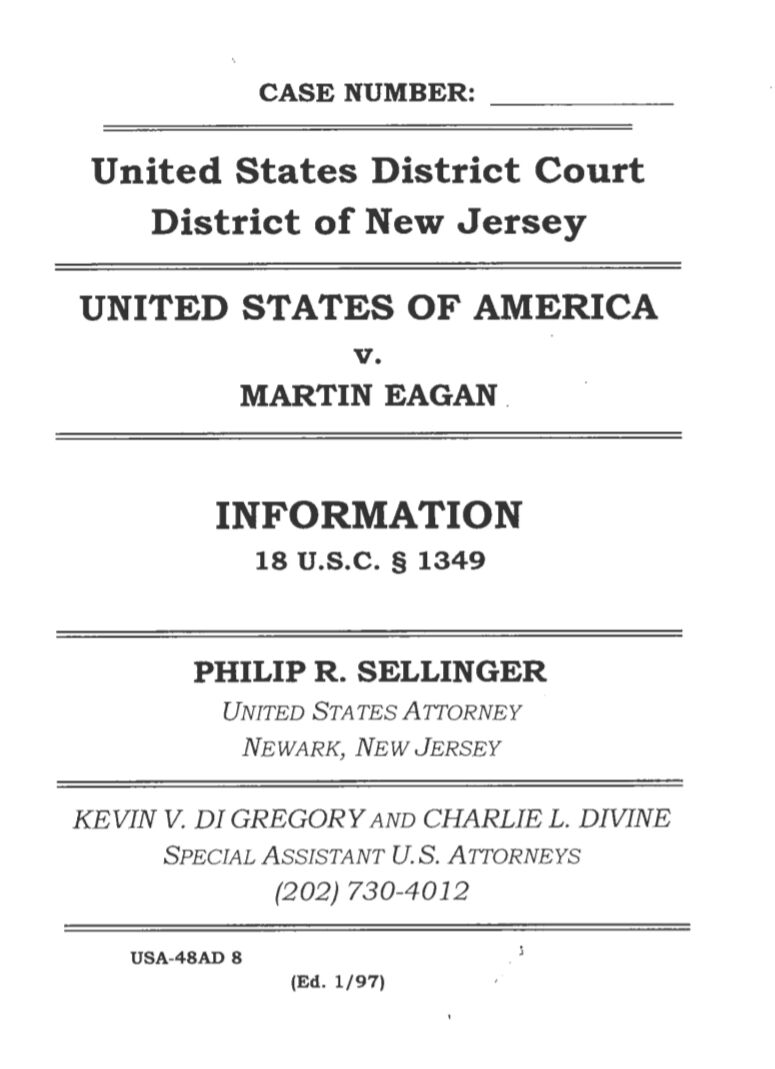
The case claims Eagan submitted false documents to lenders that encouraged them to approve funds for HECMs and refinancing mortgages. Eagan, with the help of Peralta, Puccio, and Soprano, inflated the appraised value of homes, forged signatures of homeowner-borrowers, and fraudulently dispersed funds away from homeowner-borrowers and into the bank accounts of Peralta and Puccio.
When a homeowner-borrower approached Eagan for a HECM or refinancing, Eagan used Soprano to falsely inflate the value of a homeowner’s property, then submitted false documentation to lenders without the homeowner’s knowledge. Eagan then received excess funds, of which he disbursed the agreed amount to homeowners, and funneled the excess funds to Puccio and Peralta and businesses they owned.
How does this affect me?
Fraud always creates chaos and unease within the government institution being defrauded, in this case, the U.S. government and the state of New Jersey. Morristown Minute recently posted an article about the Cost vs. Quality of Life in NJ where we identified that New Jersey has for many years had a comparably unstable economy – fraud only makes this worse.
Eagan also operated out of Morristown, where he conducted most of his business. That means Morristown residents were likely victims of Eagan, Peralta, Puccio, and Soprano’s conspiracy.
How can I protect myself?
Eagan broke the law in many ways, but most notably to borrowers, Eagan falsified documentation and HUD-1s (the distribution of funds) which are meant to be approved by the borrower prior to government and lender approval. Eagan forged signatures and went over the head of borrowers to get excess funds.
Homeowner-borrowers rely on the professionalism and trust of the closing agent, in this case, Eagan, to ensure the accuracy of the approved HUD-1s. Homeowners should follow the approved HUD-1s and any changes made thus, throughout the entire process from creation to lender approval to ensure accuracy. However, Eagan was able to falsify these reports making it nearly impossible for borrowers to prevent this fraud.
If you are unable to micromanage the itemized receipts then you need to find yourself a trustworthy lawyer, unlike Eagan.
Unfortunately, if you were a victim of Eagan, Peralta, Puccio, and Soprano’s crimes, there is little you could have done to prevent this fraud from happening.
What will happen now?
The charges filed singly against Eagan, hold a maximum sentence of 30 years in prison and a $1 million fine. Sentencing is scheduled for April 14, 2022.
For more information, and to examine the report above, see the full case, The United States Vs. Martin Eagan.
Follow Morristown Minute on Twitter, Instagram, and Facebook for more local updates.


Patchy moderate snow, with a high of 32 and low of 19 degrees. Patchy moderate snow in the morning, partly cloudy during the afternoon, clear in the evening, light snow overnight.