

Image
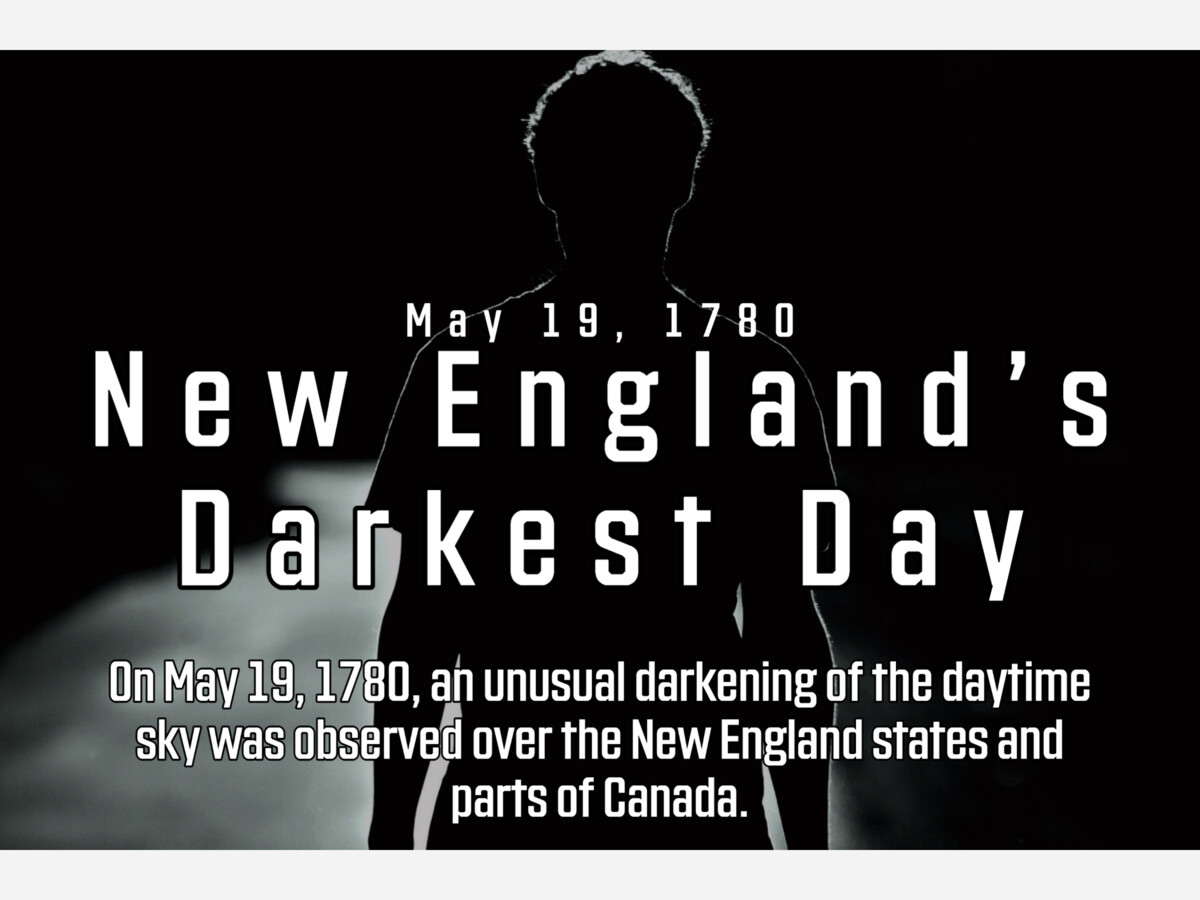
New England’s Darkest Day occurred on May 19, 1780, 242 years ago, when an unusual darkening of the daytime sky was observed over New England states and parts of Canada.
The primary cause of the event is believed to have been a combination of smoke from forest fires, a thick fog, and dense cloud cover. The darkness was so complete that candles were required from noon on. The darkened sky would not return to normal until the middle of the next night.
According to Professor Samuel Williams of Harvard College, the dense fog, cloud cover, and smoke that darkened the sky reached as far north as Portland, Maine, and extended southwards into New Jersey.
Revolutionary War soldier Joseph Plumb Martin wrote of New England’s Dark Day –
“We were here [New Jersey] at the time the "dark day" happened, (19th of May) it has been said that the darkness was not so great in New-Jersey as in New-England. How great it was there I do not know, but I know that it was very dark where I then was in New-Jersey; so much so that the fowls went to their roosts, the cocks crew and the whip-poor-wills sung their usual serenade; the people had to light candles in their houses to enable them to see to carry on their usual business; the night was as uncommonly dark as the day was.”
The earliest report of the darkening of the daytime sky came from Rupert, Vermont, where the sun was already obscured by sunrise. Professor Samuel Williams observed from Cambridge, MA, “This extraordinary darkness came on between the hours of 10 and 11 a.m. and continued till the middle of the next night.”
Reverend Ebenezer Parkham of Westborough, MA, reported peak obscurity occurred by 12, noon, but did not record when the darkness first arrived.
At Harvard College, the darkness was reported to have arrived at about 10:30 AM, peaking by 12:45 PM. By 2:00 PM the “darkness” reached Barnstable, MA, with peak obscurity reported to have occurred around 5:30 PM.
Animals and wildlife took on the routine of the night, and by all accounts, except for the clock, it looked like the darkest night in New England took place in the middle of the afternoon.
A witness to the darkness reported a strong smell of soot in the atmosphere and rainwater covered in a light film of burnt leaves and ash. Contemporaneous reports also indicated that ash and cinder fell on part of New Hampshire, accumulating at a depth of six inches.
Several days before New England’s Dark Day, the sun appeared red and the sky yellow from New England’s vantage. When the night finally came, the moon turned into a deep red and visibility dropped to near zero.
The morning of May 19, 1780, brought rain and heavy cloud cover and the beginning of intense darkness that would last for over 24 hours.
Since communication at the time was primitive, most people found the darkness baffling and inexplicable.
In Connecticut, a member of the Governor’s Council (renamed the Connecticut State Senate in 1818), Abraham Davenport, became most famous for his response to his colleagues’ fear that this darkness was the Day of Judgement –
“I am against adjournment. The day of judgment is either approaching, or it is not. If it is not, there is no cause for an adjournment; if it is, I choose to be found doing my duty. I wish therefore that candles may be brought.”
So what caused New England’s Darkest Day?
The most likely cause, as mentioned above, was smoke from a massive forest fire in Ontario, Canada combined with dense fog and heavy cloud cover.
In 2007, historians and researchers, by examining tree rings and fire scars, determined that there was evidence of a massive forest fire, in what is today Algonquin Provincial Park in eastern Ontario, in 1780 that likely contributed to the infamous Dark Day of 1780.
Follow Morristown Minute on Facebook, Instagram, and Twitter for more updates!



Sunny, with a high of 78 and low of 43 degrees. Sunny during the morning, patchy rain nearby in the afternoon and evening, clear overnight.





idiotic, follow the federal law. These are not made up laws, they were passed by Congress.