So far, 36 days into 2022, 48 fatal motor vehicle crashes have killed 51 people in New Jersey; 2 of those deaths occurred on Morris County roads.
In the first month of the year, since 2018, approximately 50 motor vehicle-related deaths occur in New Jersey.
50 % of yearly NJ MVC fatalities (dating back to 2018) claimed the life of the driver. 30% claimed the lives of one or more pedestrians, and 15% of fatalities were passengers.
New Jersey State Police, Fatal Accidents, January 2020-22
The above numbers only compare the first month of each year going back to 2018.
New Jersey's fatal motor vehicle crashes, 2018 to 2021:
The highest accident rate is among drivers ages 50 – 64, followed by drivers ages 30 – 39, then drivers ages 25-29.
Morris County saw 25 fatalities from motor vehicle crashes in 2021. Of all of New Jersey, Camden had the highest rate of fatalities with 68 vehicle-related deaths. Essex County was second with 61 deaths, followed by Atlantic with 50 deaths.
Approximately just under 10% of all motor-vehicle fatalities, dating back to 2018, occur in the first month of the year.
Each month should theoretically see just over 8% of yearly fatalities. Yet, January always proves to be a slightly more prolific time of year for MVC deaths.
The obvious reason for the statistical unbalance is the winter weather’s impact on road conditions. The months of November to January consistently show a 25% higher fatality rate than other months.
Further factors behind the increase in MVC fatalities around the beginning and end of the year may include:
Group travel – in the same vehicle or in a caravan of two or more cars. When people travel together in groups, they are generally more likely to engage in distracting behavior. Not to mention more people are on the road and traveling around these times, usually for holidays.
Students are home from school – meaning more young drivers are on the road. However, statistics show that teens, while accounting for approximately 8% of yearly fatal accidents, are involved in fatal crashes less than half as often as ages 50-64 or drivers ages 30-39. Teens get in accidents most often on weekends and mainly at dawn, and most drivers are on the roads during daytime rush hours.
Drinking and driving – as the holidays come around, there is always an increase in DWI and DUI arrests and related fatalities.
Low temperatures – vehicle performance can be impacted by low temperatures, not to mention low temps and icy, snowy, or wet conditions always make driving more dangerous.
Reckless driving – another holiday theme. Incidents of distracted driving, such as texting and driving or talking on the phone while driving spike around the end and beginning of each year. As a result, more fatalities caused by distracted driving occur in the months of November through January. Reckless driving also includes speeding, ignoring traffic rules, etc.
Vehicle maintenance – a recent study by the Department of Transportation revealed that most drivers fail to perform adequate vehicle maintenance. The study reveals that 80% of the vehicles on the roads during the winter season (Nov – Jan) have not received any previous maintenance review.
Congestion – yes, people travel in groups, yes, students are home from school. But also, everyone seems to be traveling around the winter holiday months. So roads are congested, and more people and vehicles on roads lead to more MVC fatalities. Not to mention if you live in a vacation-popular area (and even if you don’t) you’ll likely be on the road with people unfamiliar with your area and traffic laws.
Night driving – driving at night spikes in the months of November to January, partially due to the holidays, but also because days get shorter and daylight savings goes into effect. As a result, we are all on the road in the dark more often. And that obviously doesn’t help visibility while driving.
Nearly half of all fatal accidents occur at night or in the early morning when it is still dark. Sleep deprivation is also a contributing factor to nighttime MVC fatalities.



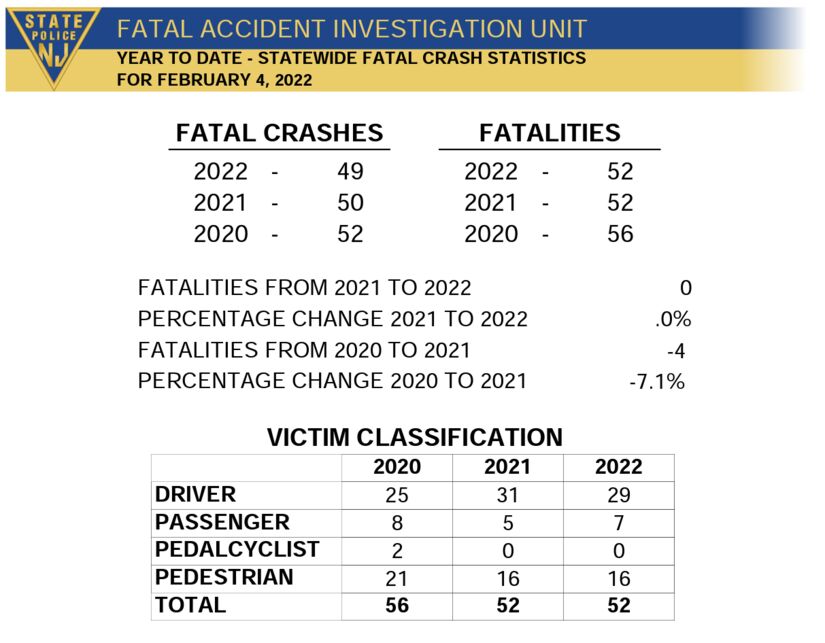 New Jersey State Police, Fatal Accidents, January 2020-22